Choosing among metal building suppliers in Canada is one of the most consequential decisions in any steel construction project. The right supplier delivers stamped engineering, code-compliant components, and a clear supply chain; the wrong one leaves buyers managing gaps in documentation, mismatched components, or unverifiable load ratings. This guide explains every factor that separates a reliable Canadian metal building supplier from a risky one, so you can evaluate your options with confidence.
- Canadian building codes (NBC and provincial variants) require stamped engineering drawings; confirm your supplier provides them.
- Pre-engineered metal buildings (PEMBs) and conventional structural steel serve different project scales and budgets.
- Supply chain origin, steel grade, and coating specifications all affect long-term performance in Canadian climates.
- Lead times, erection support, and post-sale documentation vary widely between supplier types.
- Getting multiple detailed quotes and comparing scope line-by-line is the single most effective risk-reduction step.
Definitions & scope
A metal building supplier is any company that designs, manufactures, or sources the structural steel components that make up a building system and then sells or delivers those components to an owner or contractor in Canada. The term covers a wide spectrum: fully integrated partner manufacturers that engineer, fabricate, and coordinate erection; kit suppliers that ship standardized bolt-together packages; and brokers that source components from third-party mills or offshore fabricators.
The steel building systems sold in Canada fall into two broad structural categories. Pre-engineered metal buildings (PEMBs) are factory-designed rigid-frame systems where the primary steel is optimized by computer for a specific load envelope. Conventional structural steel buildings use wide-flange sections designed project-by-project by a structural engineer of record, typically for larger or more complex structures. Most suppliers specialize in one category, though some serve both.
This guide covers the full supplier landscape for agricultural buildings, garages and shops, warehouses, aircraft hangars, and industrial facilities across all Canadian provinces and territories. Pricing, permit requirements, and snow or wind load standards vary by province; references to specific codes below are illustrative and should be verified against the current edition of the National Building Code of Canada and applicable provincial amendments.
Why this matters
Canada’s climate imposes structural demands that are among the most severe in the world. Ground snow loads in parts of British Columbia, Quebec, and Newfoundland exceed 4.0 kPa, and wind pressures on the Prairies and Atlantic coast require careful engineering attention. A supplier that does not design to the correct site-specific loads creates a building that may fail inspection, require costly remediation, or pose a safety risk.
Beyond structural performance, the supplier relationship shapes every downstream step. Permit applications require stamped drawings from a licensed engineer; if a supplier cannot provide these, the owner must hire a separate engineer to review and re-stamp imported documents, adding cost and delay. Erection crews need accurate anchor bolt layouts and connection details; errors at this stage can halt a job site for weeks.
The Canadian market also includes a significant volume of imported steel building kits, some of which carry steel grades or coating weights that do not meet Canadian standards. The Standards Council of Canada and CSA Group publish standards including CSA A660 that govern factory-built steel building systems; buyers should ask suppliers to identify which standards their products are certified to.
Finally, the supplier decision affects resale value, insurance underwriting, and the ability to obtain financing. Lenders and insurers increasingly ask for documentation of steel grade, coating specification, and engineering provenance. Choosing a supplier that provides complete documentation from the outset protects the asset throughout its life. See our guide on steel building permits and CSA-A660 compliance for more detail.
Your options
1. Integrated partner manufacturers
What it is: A company that handles engineering, fabrication, and supply coordination under one roof, acting as a single point of accountability from design through delivery. The building system is engineered to the buyer’s site conditions, fabricated to those drawings, and shipped as a matched component set.
How it works: The buyer provides site data (location, soil bearing, intended use, dimensions). The supplier’s engineering team produces stamped drawings, a bill of materials, and an anchor bolt plan. Components are fabricated and shipped with erection manuals. The supplier may coordinate or recommend erection crews but the buyer typically contracts erection separately.
Best for: Commercial warehouses, industrial facilities, aircraft hangars, large agricultural complexes, and any project where engineering documentation is required for permits or financing.
Limitations: Higher upfront cost than kit suppliers; lead times of several weeks to months depending on project complexity and fabrication capacity.
2. Pre-engineered kit suppliers
What it is: Companies that offer standardized building packages in common sizes, typically with a limited range of width, length, and eave height combinations. Engineering is pre-done for a defined load envelope; the buyer selects the closest standard size.
How it works: The buyer chooses from a catalogue. The supplier ships a kit of primary frames, secondary framing, cladding panels, fasteners, and trim. Assembly follows a standardized manual. Engineering stamps may be available for an additional fee, but are not always included.
Best for: Smaller garages, hobby shops, and agricultural storage where the standard load envelope matches the site and local permit requirements are straightforward.
Limitations: Standard load envelopes may not match sites with high snow or wind loads. Customization is limited. Engineering documentation for non-standard sites may require a third-party review. See our prefab metal buildings guide for a deeper comparison.
3. Structural steel fabricators
What it is: Fabricators that produce custom wide-flange or hollow-section steel structures designed by a structural engineer of record. These are not pre-engineered systems; every connection and member is designed for the specific project.
How it works: An engineer of record produces structural drawings. The fabricator produces shop drawings and fabricates to those documents. The owner or general contractor manages the supply chain, erection, and coordination between the engineer, fabricator, and trades.
Best for: Large industrial buildings, multi-storey structures, facilities with complex geometry, and projects where the structural engineer is already engaged. Relevant to large-scale commercial and industrial steel structures.
Limitations: Requires a separate engineer of record. Coordination burden falls on the owner or GC. Typically the highest cost per square foot for primary structure.
4. Import brokers and resellers
What it is: Companies that source steel building kits from offshore manufacturers, primarily in Asia, and resell them in Canada. Pricing is often lower than domestic suppliers.
How it works: The buyer selects a building from a catalogue. The broker places an order with an overseas fabricator. Components are shipped by container. The buyer is responsible for customs clearance, import duties, and obtaining Canadian engineering review.
Best for: Buyers with significant cost constraints, tolerance for longer and less predictable lead times, and the capacity to manage engineering review and customs independently.
Limitations: Steel grade and coating specifications may not match Canadian standards. Engineering stamps from foreign jurisdictions are not accepted by Canadian building departments without local engineer review. Warranty and after-sale support are often limited. Tariff exposure can erode price advantages; see our guide on steel building costs and tariff-free procurement.
5. Agricultural and rural building dealers
What it is: Regional dealers specializing in farm buildings, grain storage, machinery storage, and rural shops. They may represent a manufacturer’s product line or source from multiple suppliers.
How it works: The dealer provides a quote based on the buyer’s use case and site. They coordinate supply and may offer erection services or referrals to local crews familiar with agricultural construction.
Best for: Farmers and rural property owners needing livestock barns, equipment storage, or grain handling structures. See our agricultural steel buildings page for product context.
Limitations: Product range may be narrow. Engineering documentation depth varies. May not be equipped for large commercial or industrial projects.
6. Design-build contractors with steel supply
What it is: General contractors that include steel building supply as part of a turnkey design-build contract. The contractor manages engineering, supply, and erection under a single contract.
How it works: The owner signs a single contract. The contractor engages engineers, sources the building system, and manages erection. The owner has one point of contact and one contract.
Best for: Owners who want to minimize project management burden and prefer a fixed-price turnkey arrangement.
Limitations: The owner has less visibility into the steel supply chain and may not know which manufacturer’s system is being used. Markup on the building supply component is embedded in the contract price.
Options compared
| Supplier type | Best for | Typical considerations | Durability / limitations |
|---|---|---|---|
| Integrated partner manufacturer | Commercial, industrial, hangars, large ag | Full engineering documentation; single accountability; longer lead time | High; designed to site-specific Canadian loads |
| Pre-engineered kit supplier | Small garages, hobby shops, simple ag storage | Faster delivery; limited customization; stamps may cost extra | Good for standard load zones; risk in high-load sites |
| Structural steel fabricator | Large industrial, complex geometry, multi-storey | Requires separate engineer of record; highest coordination burden | Very high; fully custom-engineered |
| Import broker / reseller | Cost-constrained buyers with project management capacity | Lowest list price; tariff and code-review risk; long lead times | Variable; depends on offshore fabricator quality |
| Agricultural / rural dealer | Farm buildings, rural storage | Regional knowledge; limited to ag product range | Good for intended ag use; not suited to industrial loads |
| Design-build contractor | Turnkey buyers; minimal owner involvement | Single contract; supply chain less transparent; markup embedded | Depends on which manufacturer system is sourced |
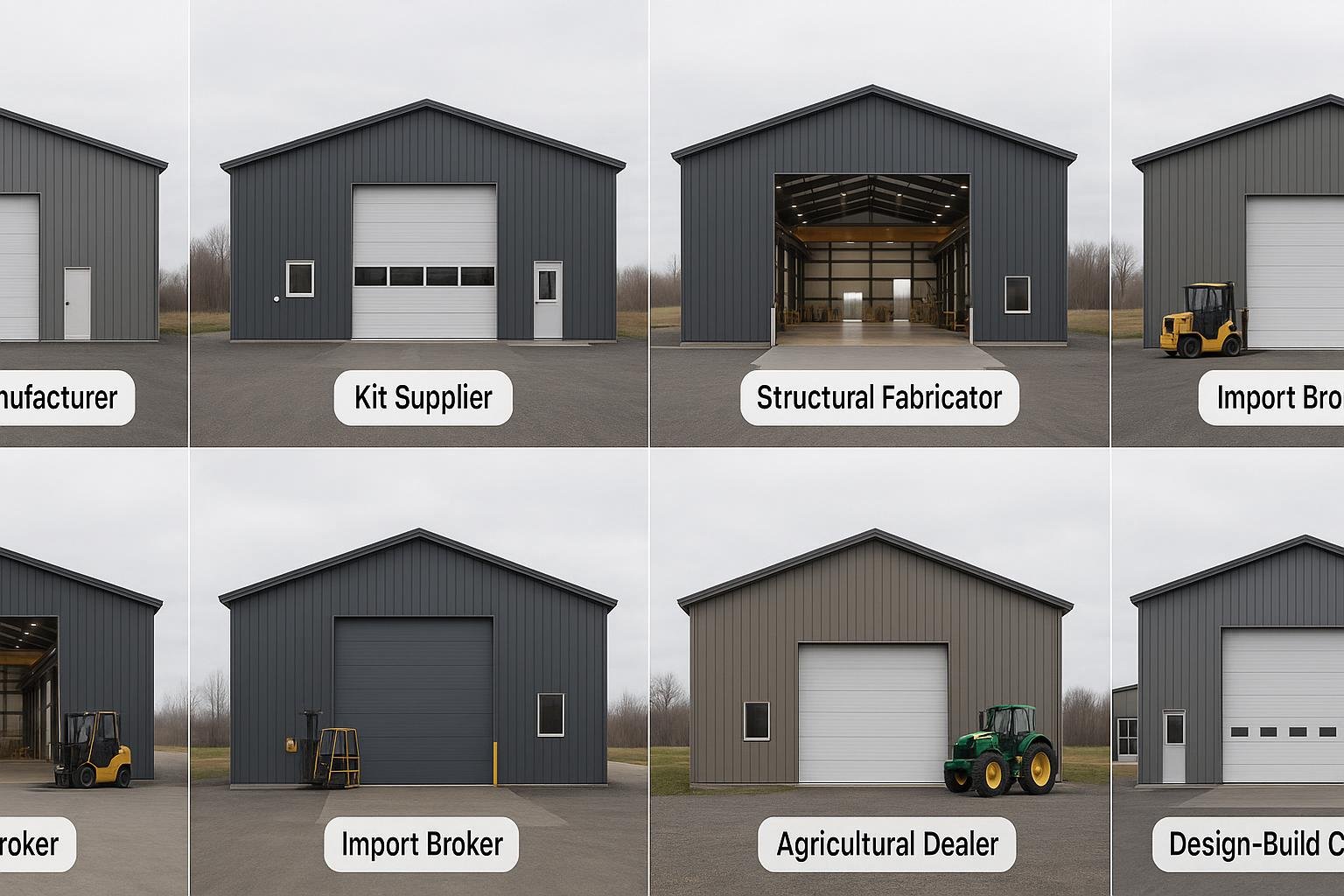
The table above shows that no single supplier type is optimal for every project. Integrated partner manufacturers offer the most complete documentation and accountability, which matters most for permitted commercial and industrial projects. Kit suppliers and agricultural dealers serve simpler projects efficiently. Import brokers introduce risks that are manageable only when the buyer has the expertise to navigate code review and customs. Design-build contractors trade transparency for convenience. Match the supplier type to your project’s complexity, documentation requirements, and your own capacity to manage the supply chain.
How to choose
Choose an integrated partner manufacturer if your project requires building permits, financing, or insurance documentation; if the building will be used for commercial, industrial, or aviation purposes; if the site has above-average snow or wind loads; or if you want a single point of accountability from engineering through delivery. This is also the right choice when the building will be occupied by employees or the public, where code compliance is non-negotiable.
Choose a pre-engineered kit supplier if your project is a small personal garage, hobby shop, or simple agricultural storage structure; the site is in a standard load zone; local permit requirements are minimal; and you have the skills or a local contractor to manage erection from a standardized manual.
Choose a structural steel fabricator if your project is large, complex, or multi-storey; you already have a structural engineer of record engaged; or the building geometry cannot be accommodated by a pre-engineered system. Review our PEMB vs. conventional steel comparison before making this decision.
Choose an import broker only if you have a licensed Canadian structural engineer available to review and re-stamp foreign drawings, you understand the current tariff environment, and you have the project management capacity to handle customs, logistics, and potential component discrepancies.
Choose a design-build contractor if your priority is a single contract and minimal owner involvement, and you are comfortable with reduced visibility into the steel supply chain. Ask the contractor to disclose the manufacturer and provide the engineering documentation directly to you.
Choose an agricultural or rural dealer if your project is a farm building, livestock barn, or rural equipment storage structure and you want a supplier with regional knowledge of agricultural construction practices. See our metal farm buildings guide for more context.
Costs & timelines
No verified current price data has been supplied to this page. The following describes the cost drivers that influence supplier quotes, ranked by typical impact. For project-specific pricing, request a detailed quote from a qualified supplier.
| Cost driver | Why it matters | Relative impact |
|---|---|---|
| Building size (footprint and eave height) | Primary determinant of steel tonnage and fabrication hours | Very high |
| Structural steel grade and coating specification | Higher-grade or heavier-coated steel costs more but lasts longer in Canadian climates | High |
| Site-specific load requirements | High snow or wind loads require heavier primary frames; increases steel tonnage | High |
| Openings (doors, windows, skylights) | Each opening requires header framing and affects cladding layout | Moderate |
| Insulation specification | Thermal performance requirements drive insulation type and thickness; see our steel building insulation guide | Moderate |
| Delivery distance and logistics | Remote sites in northern Canada face higher freight costs | Moderate |
| Erection cost | Labour rates vary by province and season; erection is typically contracted separately from supply | Moderate to high |
| Foundation type and site preparation | Soil conditions, frost depth, and drainage affect foundation cost; see our foundation requirements guide | Moderate to high |
Timeline from order to delivery varies by supplier type and project complexity. Simple kit orders may ship in weeks; fully engineered custom buildings typically require several months from signed drawings to delivery. Factor in permit approval timelines, which vary by municipality, when planning your project schedule. Our metal building prices and cost guide provides additional context on what drives quotes.
Risks & common mistakes
Accepting a quote without a full scope of supply. Many low quotes exclude secondary framing, cladding, trim, fasteners, or engineering stamps. Compare quotes line-by-line against a defined scope before selecting a supplier.
Not verifying engineering credentials. In Canada, structural drawings must be stamped by a professional engineer licensed in the province where the building will be erected. A stamp from another jurisdiction is not automatically accepted. Ask the supplier to confirm the licensing province of their engineer of record before signing a contract.
Underspecifying snow and wind loads. Using a standard catalogue load envelope for a site with higher-than-average loads is a common and serious error. Provide the supplier with your municipality and postal code so they can look up the correct ground snow load and wind pressure from the NBC climatic data tables.
Ignoring the tariff environment. Steel import tariffs in Canada have changed multiple times in recent years and can significantly affect the landed cost of imported building kits. Confirm the tariff status of any imported product before committing to a price. Our tariff-free procurement guide explains the current landscape.
Skipping the 2026 buyer’s guide evaluation checklist. Our 2026 buyer’s guide to evaluating metal and steel building suppliers provides a structured checklist for vetting suppliers before committing.
Assuming all steel is equivalent. Steel grade, yield strength, and coating weight differ between suppliers and between domestic and imported products. Ask for the steel specification (e.g., CSA G40.21 grade) and the coating weight on cladding panels (e.g., AZ150 or AZ180 Zincalume) and verify these meet your project requirements.
Not planning for erection. The building kit is only part of the project. Erection labour, crane rental, and site access must be planned and budgeted before ordering. Some suppliers can recommend experienced erection crews; others do not. Clarify this before signing.
How the process works
- Define your project requirements. Establish the intended use, approximate dimensions, site location, required openings, insulation needs, and any special loads (overhead cranes, mezzanines, heavy equipment). The more detail you provide, the more accurate the initial quote.
- Request quotes from qualified suppliers. Contact at least two or three suppliers with your project brief. Ask each to provide a detailed scope of supply, the steel specification, the engineering stamp arrangement, and an estimated lead time. Use our steel building supplier page as a starting point.
- Review and compare quotes line-by-line. Confirm that each quote includes the same scope: primary frames, secondary framing, cladding, trim, fasteners, engineering drawings, and any accessories. Identify exclusions and request clarification before comparing prices.
- Confirm engineering and permit documentation. Before signing, confirm that stamped drawings will be provided for your province, that the engineer of record is licensed in that province, and that the drawings will be sufficient for your building permit application.
- Place the order and confirm the production schedule. Once the contract is signed, the supplier will begin engineering and fabrication. Confirm the expected ship date and coordinate with your foundation contractor so the site is ready when the building arrives.
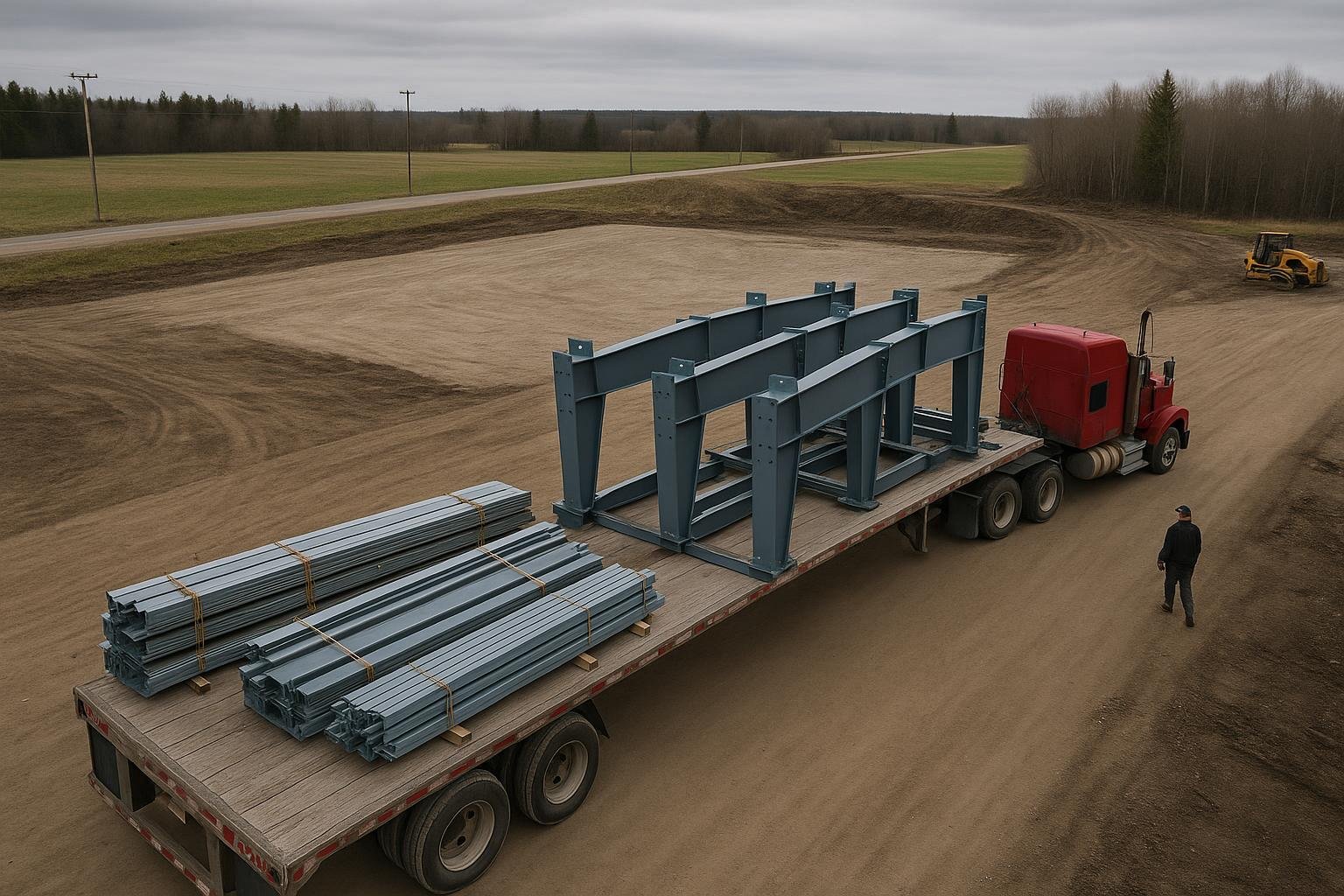
- Receive delivery and inspect components. Upon delivery, inspect all components against the bill of materials before the truck leaves. Note any damage or missing items immediately. Most suppliers have a defined process for handling shipping damage claims.
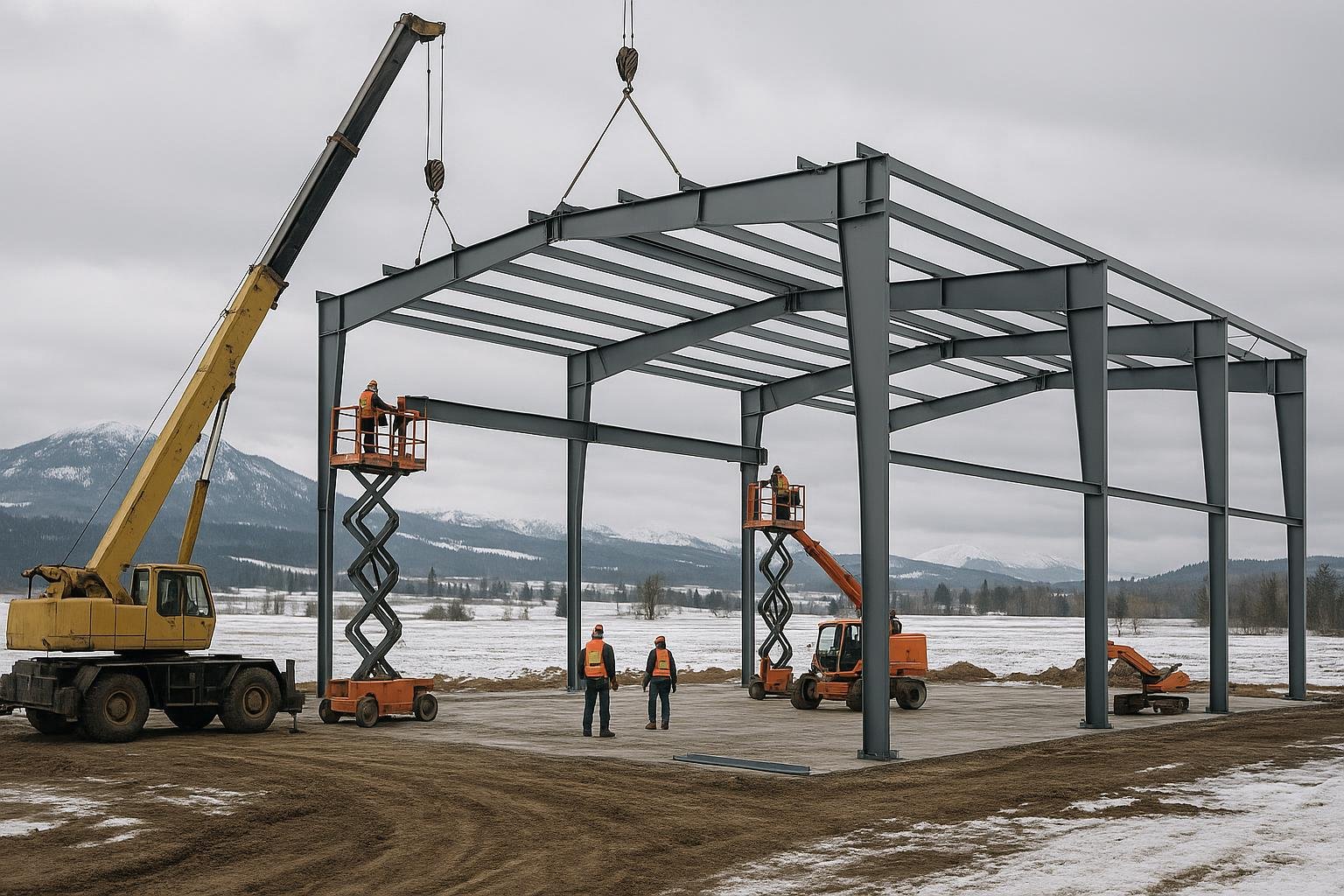
- Erect and close out documentation. Work with your erection crew to assemble the building per the erection manual. Once complete, obtain any required inspections and collect all as-built documentation, warranties, and maintenance records for your files.
Frequently asked questions
What is the difference between a metal building supplier and a steel building manufacturer?
The terms are often used interchangeably, but there is a meaningful distinction. A manufacturer fabricates the steel components in its own facility. A supplier may manufacture, source from a partner fabricator, or broker components from third parties. When evaluating a supplier, ask directly whether they fabricate in-house or source externally, as this affects quality control, lead time predictability, and accountability when problems arise.
Do metal building suppliers in Canada provide stamped engineering drawings?
Reputable integrated suppliers and partner manufacturers provide stamped engineering drawings as part of their standard scope. Kit suppliers and import brokers may offer drawings as an add-on or may not provide Canadian-stamped drawings at all. Always confirm before signing a contract that stamped drawings from a professional engineer licensed in your province are included. Without them, your building permit application will be incomplete.
How do I know if a supplier’s steel meets Canadian standards?
Ask the supplier to specify the steel grade by standard designation. Structural steel in Canada is commonly specified to CSA G40.21, which defines yield strength grades. Cladding panels should specify the coating weight (e.g., AZ150 or AZ180 for Zincalume-type coatings). If a supplier cannot provide these specifications in writing, treat that as a significant risk indicator.
How long does it take to receive a metal building after ordering?
Lead times vary widely. Standardized kit buildings may ship in a few weeks. Fully engineered custom buildings for commercial or industrial use typically require several months from signed contract to delivery, accounting for engineering, permit approval, fabrication, and logistics. Remote delivery locations in northern Canada add further time. Always confirm the production and ship schedule in writing at the time of order.
Can I supply my own foundation and hire a separate erection crew?
Yes. Most metal building suppliers sell the building system only and expect the buyer to arrange foundation work and erection separately. The supplier provides an anchor bolt plan that must be followed precisely during foundation construction. Some suppliers can recommend erection crews; others leave this entirely to the buyer. Clarify the supplier’s role in erection support before signing. Our foundation requirements guide covers what the foundation contractor will need.
What building types can metal building suppliers in Canada supply?
The range is broad. Common applications include agricultural buildings (livestock barns, equipment storage, grain handling), garages and personal shops, commercial warehouses, industrial manufacturing facilities, aircraft hangars, cold storage buildings, and recreational structures. Suppliers vary in which segments they serve; confirm that the supplier has experience with your specific building type before proceeding. Titan’s product range includes agricultural buildings, steel warehouses, aircraft hangars, and commercial steel buildings.
Are imported metal building kits legal in Canada?
Importing a steel building kit is legal, but the building must still comply with the National Building Code of Canada and applicable provincial codes before a permit will be issued. Engineering drawings produced in a foreign jurisdiction must be reviewed and stamped by a professional engineer licensed in the relevant Canadian province. Import duties and tariffs apply and have varied in recent years. Buyers should factor in the full landed cost, including engineering review, before comparing imported kit prices to domestic supplier quotes.
What questions should I ask a metal building supplier before signing a contract?
Key questions include: What steel grade and coating specification will be used? Are stamped engineering drawings included, and is the engineer licensed in my province? What is the full scope of supply and what is excluded? What is the production and delivery schedule? How are shipping damage claims handled? What warranty is provided on the structure and on cladding? Can you provide references from projects of similar type and size? Our guide on working with a steel building partner expands on this checklist.
How do snow and wind loads affect which supplier I should choose?
Sites with high ground snow loads or significant wind exposure require heavier primary frames and, in some cases, different connection details. A supplier using a standard catalogue load envelope may not design for your site’s actual loads. Integrated partner manufacturers design to site-specific loads derived from NBC climatic data tables. Always provide your site location to the supplier and ask them to confirm the design loads used. Our steel building snow load guide explains how loads are determined across Canada.
Does Titan Steel Buildings supply metal buildings across all of Canada?
Titan Steel Buildings serves customers across Canada, including Ontario, Alberta, British Columbia, Quebec, Saskatchewan, Manitoba, Nova Scotia, New Brunswick, Newfoundland and Labrador, and other provinces and territories. Project inquiries can be submitted through the get a quote page for a scope-specific response.
If you are ready to move forward or want to compare options for your specific project, the Titan Steel Buildings team can provide a detailed scope review and quote. Visit our steel building supplier page or explore our full range of metal buildings to learn more about what we supply across Canada.